12/19/25 Newsletter - Chasing the Light (5/6)

In our quest to make paintings about the way light affects perception, we have discussed light microscopy, illumination techniques, specimens and photomicrography. This week, we will be meeting the organism chosen as model for the paintings: Stylaria Lacustris.
Stylaria Lacustris
Stylaria lacustris is a species of freshwater annelid, that is, a segmented worm. [1] Members of this species can be found almost worldwide, being present in Asia, Europe, Australia, North and South America. [7,1]. Their most common habitats are ponds and lakes [8], but sometimes they can be found in brackish water as well [7]. They feed primarily on algae.
Individuals can range in length from 3.5 to 12 mm [8,9]. Usually, they reproduce asexually, with sexual reproduction occurring rarely, mostly in times of environmental stress. [8]


How to Identify it
S. Lacustris is part of the subclass Oligochaeta. [2] Oligo-, from Greek, meaning "few, little" [3] and chaeta, which can be understood as "bristles"[4]. Chaetea are present in most annelid worms and are usually made of chitin [6]. It is a good way to differentiate them from other types of worms, like nematodes.
The diagnostic feature of S. Lacustris is usually its proboscis that originates from the middle of two lobes [1,5]. If you see a very similar worm but with a proboscis that seems to be a smooth continuation of its face, it is probably Stylaria fossularis. [1,5] Another easily noticeable morphological feature is the presence of eyes. [7]
Time to Paint
The main reason why I chose this particular species was because I ended up accidentally crushing the specimen I had with a pipette. I have not attempted to use live organisms since so I can study ways to not harm them more.
I was able to capture a few pictures before it happened, so that is what I will be using as reference:

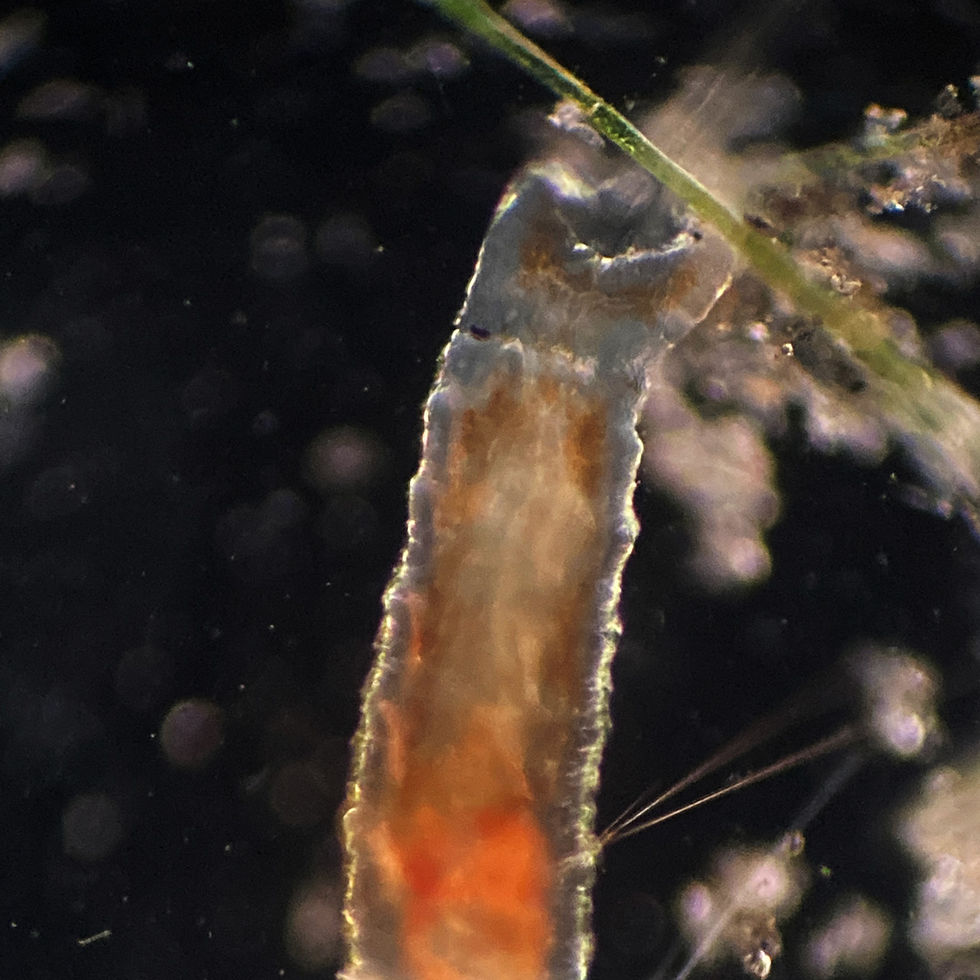
Since one painting will depict the view in brightfield, and the other darkfield, I will need two copies of the same drawing. Using tracing paper is the best way to guarantee that both drawings will be mostly identical. I first sketched on drawing paper, then traced the sketch onto tracing paper. By rubbing the back of the tracing paper, the graphite is transferred to watercolor paper, leaving a mirrored copy of the original drawing.


The paintings will be around 12.7x17.78cm (5x7 inches) each. They will be made using watercolor and gouache. Next week, I will be sharing the final paintings and a few closing thoughts on everything we have discussed over the past 5 weeks!
What's Next?
So far we have discussed:
Making paintings based on the photographs (This)
The following newsletter will arrive a few days earlier so that it gets to you a little before Christmas.
If you have any questions, send an e-mail to contact@maxflores.art.
See you next week!
References
Horenkamp, Austin J. An Analysis of Species-Level Diversity of the Freshwater Clitellate Genus Stylaria and an Analysis of Novel Motochondrial Genomes for 5 Naidid Annelids. Southern Illinois University at Carbondale, 2023.
Timm, Tarmo, and Patrick J. Martin. "Clitellata: oligochaeta." In Thorp and Covich's freshwater invertebrates, pp. 529-549. Academic Press, 2015.
“Oligo- Definition & Meaning.” Dictionary.com. Accessed December 18, 2025. https://www.dictionary.com/browse/oligo.
“Chaeta Definition & Meaning.” Merriam-Webster. Accessed December 18, 2025. https://www.merriam-webster.com/dictionary/chaeta.
Klemm, Donald J. A guide to the freshwater annelida (Polychaeta, Naidid and Tubificid Oligochaeta, and Hirudinea) of North America. Dubuque, IA: Kendall/Hunt Pub. Co, 1985.
Rouse, Greg, Fredrik Pleijel, and Ekin Tilic. Annelida. Oxford University Press, 2022.
Sperber, Christina. A taxonomical study of the naididae. Uppsala: Almqvist & Wiksells boktr, 1948.
Armendáriz, Laura C. "Population dynamics of Stylaria lacustris (Linnaeus, 1767)(Oligochaeta, Naididae) in Los Talas, Argentina." Hydrobiologia 438, no. 1 (2000): 217-226.
Kaliszewicz, Anita. "Sublethal predation on Stylaria lacustris: a study of regenerative capabilities." Hydrobiologia 501, no. 1 (2003): 83-92.


Comments