11/28/25 Newsletter - Chasing the Light (2/6)

In our quest to make paintings exploring the way in which light affects perception, we delved into Light Microscopy last week.
Now it's time to play with light and explore more in depth one of the ways in which we can illuminate our subjects: Darkfield.
What is Darkfield?
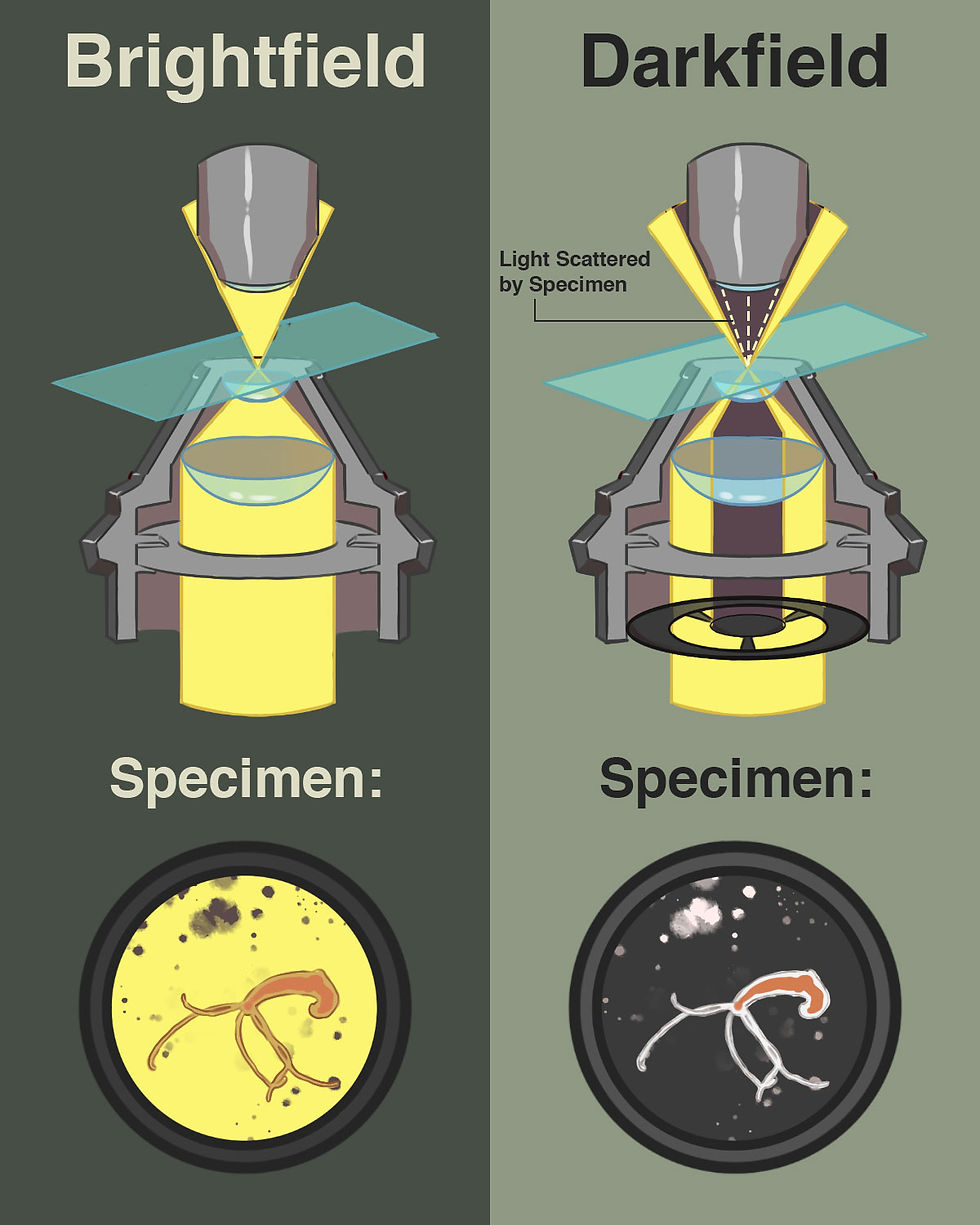
Darkfield is an illumination technique used in microscopy to produce images with a dark, black background. However, it should not be mistaken as being the opposite of bright field. The colors are not inverted, like in a negative image.
What is happening is very simple: a filter is placed on the microscope aligned in a way so that it blocks the center of the light ray, but not the sides.
The specimen is then illuminated by those oblique rays coming from the sides. Only the light rays scattered by the specimen will be collected by the objective lens of the microscope. This translates into an image in which the specimen is seen brightly illuminated, while the background remains dark. This is very useful for seeing specimens that appear low in contrast in bright field.
The Olympus BH2 Problem
While most modern microscopes have a swing out filter holder that makes it very easy to
just insert such filters, this is not the case for older models like mine, the Olympus BH2.
Luckily, an easy workaround to this problem is to 3D print a filter holder instead. I used
files made by Carl Hunsinger and printed them at the local library. After a few failed attempts, I finally got a working result. Now all I need to do is put it on my microscope...


Dust Everywhere
This was the first picture I took, my darkfield just doesn't seem...dark. What's happening? Due to the way darkfield works, any minuscule speck of dust or oil will be shinning bright against the dark background just like the specimen.
I thoroughly cleaned my microscope, and the results improved. Here is a comparison showing how dust is much more distracting in darkfield:


One problem still remains: I always need to pick debris in my samples in order to find microorganisms. How can we solve this issue? That's what we will be discussing next week, Specimen Preparation.

Website Update
I have added 3 new sections to my website: Photomicrography, Blog and Gear. In Photomicrography, you'll be able to see a collection of pictures I've taken. It is currently very modest, but I will be expanding it each week.
In Blog, you'll be able to read all newsletters that are one week old or older. Eventually, I will add longer posts there as well.
Lastly, in Gear, you'll be able to easily see all the tools and
materials I use for photomicrography, traditional media and digital media paintings. My goal is to make it easy for people to see materials in use and figure out what they need to buy.
What's Next?
So far we have discussed:
Setting up different illumination techniques: Darkfield (This)
In the following newsletters, we will go over:
Specimen collection and preparation
Photographing specimens
Making paintings based on the photographs
Results
If you have any questions, send an e-mail to contact@maxflores.art.
See you next week!


Comments